Malignant melanoma is a fatal cutaneous malignancy marked by aberrant melanocyte proliferation and disrupted metabolic-immune homeostasis. Though anti-PD-1/PD-L1 immune checkpoint inhibitors have remarkably improved survival for subsets of melanoma patients, therapeutic response rates remain unsatisfactory. Only 15–25% of patients with various malignancies achieve favorable responses, and approximately one-third of initial responders will experience disease relapse [1,2]. Hence, identifying predictive biomarkers and drug resistance mechanisms is critical to boosting the efficacy of immune checkpoint blockade (ICB).
Most prior research has centered on the transcriptional regulation of PD-L1, yet the dynamic mechanisms governing PD-L1 protein stability have long remained elusive. Studies indicate that beyond energy metabolism, mitochondria modulate protein functions via post-translational modifications (PTMs), including acetylation, malonylation and succinylation [3,4]. Accordingly, dissecting PTM-associated mechanisms constitutes a vital research frontier. In addition, how tumor metabolic reprogramming reshapes the immune microenvironment has attracted growing research attention. Specifically, the way mitochondrial metabolites (e.g., α-ketoglutarate, succinate) regulate immune checkpoint proteins through PTMs has become a key breakthrough to overcome immunotherapy resistance.
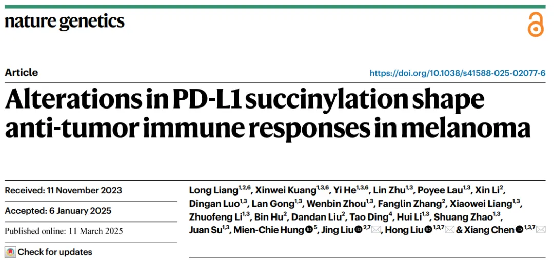
On March 11, a collaborative team led by Professors Chen Xiang, Liu Hong and Liu Jing from Furong Laboratory and Central South University published an original research paper titled Alterations in PD-L1 succinylation shape anti-tumor immune responses in melanomain the top international journalNature Genetics. For the first time, this study elucidates the core mechanism whereby the mitochondrial metabolic enzyme CPT1A mediates PD-L1 protein degradation via succinylation modification. The team also proposes an innovative combinatorial regimen pairing CPT1A activators with immunotherapy for melanoma, delivering a precise therapeutic target for melanoma immunotherapy.
Breaking Through Immunotherapy Bottlenecks via Metabolic Regulation
Multi-omics profiling revealed succinyl-CoA as a core regulatory mediator. Metabolic manipulation activates the PD-L1 degradation cascade: supplementation with α-ketoglutarate (DMK) or succinate (DES) drastically elevates intracellular succinyl-CoA levels and accelerates PD-L1 degradation through the lysosomal pathway.
Mechanistic experiments validated that CPT1A acts as a succinyltransferase to catalyze succinylation at lysine 129 (K129) of PD-L1, triggering PD-L1 clearance via the late endosome-lysosome axis. Gene editing assays confirmed that the K129R mutant resists degradation, whereas the K129E mutant (succinylation-mimicking) drastically shortens PD-L1 half-life. This discovery offers an unprecedented perspective to resolve immunotherapy resistance.
In preclinical models, the study innovatively identified bezafibrate, a CPT1A activator, as an immunotherapy sensitizer, which is expected to provide a safer and more accessible combination treatment for patients with advanced melanoma. Clinically, a therapeutic response prediction model built based on the protein expression levels of CPT1A and PD-L1 exhibits robust predictive performance, laying a solid theoretical foundation for precise patient stratification. The strong translational potential of these findings highlights the tight integration between basic research and unmet clinical demands.
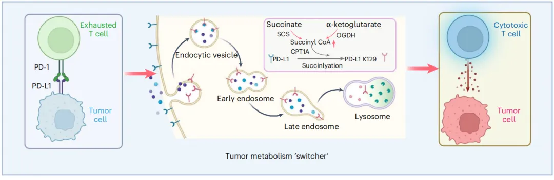
Schematic Diagram of Core Mechanisms
Scientific Significance and Future Research Directions
This study identifies succinylation as a pivotal "molecular switch" controlling PD-L1 degradation for the first time, breaking the conventional research paradigm for protein stability. As a master enzyme with dual regulatory roles in metabolism and immunity, CPT1A represents a novel target to reverse immunotherapy resistance.
The research findings are not limited to melanoma, but may provide universal therapeutic strategies for other solid tumors driven by metabolic reprogramming such as lung cancer and colorectal cancer, bearing far-reaching public health value. As an approved safe pharmaceutical agent, bezafibrate-based combination therapy can drastically cut investment in new drug R&D and benefit more patients. Furthermore, modulating endogenous succinyl-CoA concentrations through dietary or metabolic interventions may evolve into an adjuvant cancer treatment approach. For instance, foods rich in α-ketoglutarate precursors (broccoli, spinach, etc.) may exert synergistic anti-tumor effects.
Meanwhile, the development of simple CPT1A-based detection kits to screen patients eligible for immunotherapy will facilitate the popularization of precision oncology. Future work will further explore the broad applicability of the CPT1A-PD-L1 regulatory axis across multiple cancer types and optimize combination regimens of metabolic drugs and immunotherapy. The team also plans to develop CPT1A-based clinical detection tools to support personalized precision treatment.
In summary, this study demonstrates that succinyl-CoA potentiates T cell-mediated anti-tumor immunity by modulating PD-L1 succinylation and degradation. It validates CPT1A as a promising therapeutic target and biomarker, proposing a novel strategy for melanoma immunotherapy.
Corresponding authors: Professor Chen Xiang, Professor Liu Hong and Professor Liu Jing (Furong Laboratory, Central South University). Co-first authors: Associate Research Fellow Liang Long, Research Fellow Kuang Xinwei, and PhD candidate He Yi (Central South University).
Over the years, the team has published a series of landmark original works in tumor immunotherapy:
A novel adenosine-driven regulatory mechanism of tumor PD-L1 (Cancer Cell, 2020)
Sex-based molecular disparities in cancer immunotherapy (Nature Communications, 2020)
Novel MMP-mediated tumor immune regulatory mechanisms (Genome Medicine, 2020)
Sunitinib-modulated anti-tumor immunotherapeutic mechanisms (Advanced Science, 2020)
Sex differences in immune-related adverse events during cancer immunotherapy (Journal of the National Cancer Institute, 2021)
Autophagy inducers as sensitizers for anti-tumor agents (Nature Communications, 2022)
Novel immunostimulatory nanomedicines for cancer treatment (Chemical Engineering Journal, 2022)
Albendazole-mediated enhancement of anti-tumor immunity (Journal for ImmunoTherapy of Cancer, 2022)
Circadian molecule RORA boosts anti-tumor immune responses (Cancer Research, 2024)
This research marks another landmark output of Furong Laboratory’s tumor immunology program. Furong Laboratory is continuously recruiting mid-career and young researchers as well as full-time postdocs with competitive benefits. Interested candidates please submit your CV to the mailbox: xyyxyyxrsb@csu.edu.cn.
Original paper DOI: 10.1038/s41588-025-02077-6
First Reviewer: Wang Zhixin; Second Reviewer: Li Ruijun; Final Reviewer: Xiang Bo; Translator: Zeng Xiangni



