As the new year unfolds, the Department of Dermatology and Venereology, Xiangya School of Medicine, Central South University, has successively released multiple landmark research findings in world-leading academic journals, demonstrating its profound academic strength and global influence in dermatological research. Notably:
The team led by Professor Chen Xiang and Associate Professor Xiao Yi published research in The Lancet revealing shifting patterns of global skin disease spectrums;
The team headed by Professor Lu Qianjin and Professor Wu Haijing released original research on keratinocyte-derived metabolic alarmins in Nature;
The research group of Professor Li Ji and Professor Deng Zhili published pioneering work on metabolic regulatory mechanisms and targeted drug development for rosacea in Cell.
I. Professor Chen Xiang & Associate Professor Xiao Yi’s Team Publishes Global Research on Shifting Skin Disease Spectrums in The Lancet
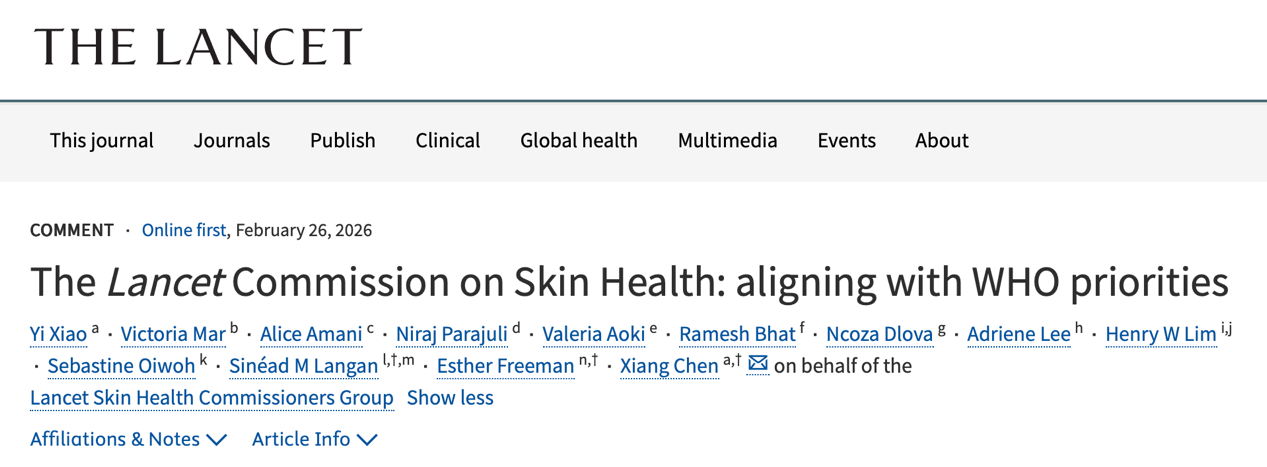
On February 26, a collaborative team led by Professor Chen Xiang and Associate Professor Xiao Yi from The First Xiangya Hospital, Professor Esther E. Freeman from Massachusetts General Hospital, and Professor Sinéad M. Langan from the London School of Hygiene & Tropical Medicine published a paper in The Lancet. The study systematically analyzed evolving global skin disease spectrums and addressed three critical unresolved questions in global skin health.
On this occasion, The Lancet announced the establishment of its inaugural Global Skin Health Committee, chaired by The First Xiangya Hospital. Bringing together scholars across continents specializing in dermatology, disease burden, epidemiology and implementation science, this initiative represents the first high-level global academic program dedicated to skin health.
The Committee will focus on three core priorities:
Uncovering preventable and intervenable skin disease burdens and their key driving factors across regions and all life stages;
Setting quantifiable targets and exploring implementation pathways for universal skin health coverage, including community health education and integrated primary care services;
Defining a core package of essential global skin health services covering disease prevention, diagnosis and equitable drug access.
Drawing on regional case studies, the Committee will outline major challenges and differentiated intervention strategies, while exploring four pivotal research directions: analyzing how industrialization reshapes skin disease spectrums; mapping the global distribution of dermatological workforce and identifying strategies to boost service capacity; documenting public health dilemmas in nations with dual skin disease burdens; and leveraging artificial intelligence to enable early detection and standardized management of cutaneous malignancies such as melanoma. The Committee plans to release comprehensive reports and policy guidelines, host cross-regional academic forums and ministerial roundtables, and collaborate closely with the World Health Organization and global patient communities to align scientific research, clinical practice and public policy toward universal skin health coverage.
II. Professor Lu Qianjin & Professor Wu Haijing’s Team Releases Research on Keratinocyte Metabolic Alarmins in Nature
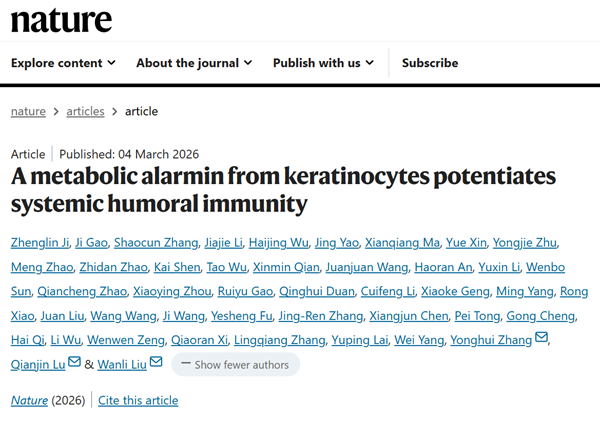
On March 4, joint research led by Professor Lu Qianjin and Professor Wu Haijing, alongside teams from Professor Liu Wanli (School of Life Sciences, Tsinghua University) and Professor Zhang Yonghui (School of Pharmaceutical Sciences, Tsinghua University), published an original research article titled A metabolic alarmin from keratinocytes potentiates systemic humoral immunityin top international journal Nature.
Professor Lu Qianjin (Distinguished Professor, Institute of Dermatology, Chinese Academy of Medical Sciences & The Second Xiangya Hospital), Professor Zhang Yonghui and Professor Liu Wanli serve as co-corresponding authors. Ten researchers including Professor Wu Haijing (The Second Xiangya Hospital, Furong Laboratory) and PhD student Xin Yue from The Second Xiangya Hospital are listed as co-first authors. The study received robust support from Professor Xiao Rong, Associate Researcher Yang Ming, Dr. Zhao Zhidan and PhD student Shen Kai of The Second Xiangya Hospital.
For the first time, this study identifies farnesyl pyrophosphate (FPP), a metabolic intermediate produced by keratinocytes (KCs), as an endogenous immune alarmin. It further elucidates the FPP–TRPV3–IL-6/CCL20–GC signaling axis that governs systemic humoral immunity, with activation levels of this pathway positively correlated with the Cutaneous Lupus Erythematosus Disease Area and Severity Index (CLASI).
The research not only deciphers the molecular mechanism by which local cutaneous signals regulate systemic humoral immunity, but also delivers an innovative answer to the core scientific question of how localized infection triggers systemic antibody responses. It also provides potential therapeutic targets and new strategies for novel vaccine adjuvant development and clinical management of autoimmune diseases such as systemic lupus erythematosus (SLE). Parallel work from the team, titled Aromatic TRPV3 agonists act as titratable organic adjuvants to enhance antigen-specific IgG responses, was simultaneously published inImmunity & Inflammation.
III. Professor Li Ji & Professor Deng Zhili’s Team Reports Breakthroughs in Rosacea Metabolic Regulation and Targeted Drug Discovery in Cell
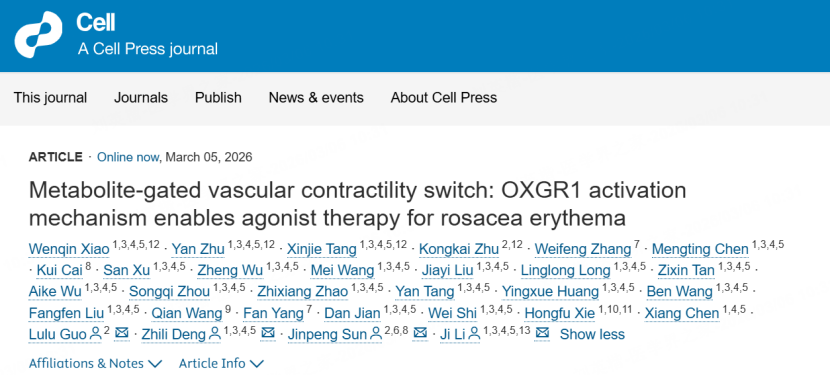
On March 5, a collaborative team led by Professor Li Ji and Professor Deng Zhili, together with Professor Sun Jinpeng and Professor Guo Lulu from Shandong University, published landmark findings on metabolic regulatory mechanisms and targeted drug development for rosacea in Cell. The First Xiangya Hospital of Central South University acts as both the primary institutional affiliation and primary corresponding unit for the paper. Professors Li Ji, Deng Zhili, Sun Jinpeng and Guo Lulu are co-corresponding authors; Physician Xiao Wenqin, Dr. Zhu Yan, Dr. Tang Xinjie and Professor Zhu Kongkai serve as co-first authors.
The research discovers elevated serum alpha-ketoglutarate (α-KG) in rosacea patients, which activates the G protein-coupled receptor OXGR1 to suppress pathological vasodilation and relieve facial erythema. The team also developed A-1, a novel selective OXGR1 agonist, offering an innovative therapeutic solution for persistent erythema in rosacea. This study achieves a complete closed-loop research workflow spanning clinical metabolomics, disease pathogenesis, receptor signal transduction and AI-assisted drug design, marking a major milestone in mechanistic research and targeted drug development for rosacea.
Founded one year ago under the forward-looking leadership and strategic planning of Xiangya School of Medicine, the Department of Dermatology and Venereology has achieved rapid and robust growth. On the anniversary of its establishment, the department has shone brightly on the global academic stage, with three consecutive high-impact publications in world-leading journals released this spring. These breakthroughs span global skin disease epidemiological shifts, keratinocyte metabolic alarmin immunology, and translational research on rosacea metabolism and targeted therapeutics, contributing distinctive Xiangya insights to international dermatological research. Such remarkable achievements stem from Central South University’s strategic integration of internal medical resources and cross-disciplinary collaborative development.
Looking ahead, the Department of Dermatology and Venereology will uphold the fine traditions and pioneering spirit of Xiangya School of Medicine. It will deepen interdisciplinary partnerships, focus on fundamental scientific challenges in dermatology, tightly integrate basic research with clinical translation, expand international academic exchanges, and continuously elevate its global academic standing. Supported by sustained institutional care and backing from Xiangya School of Medicine, the department is poised to write new chapters of outstanding academic achievement.
First Reviewers: Liu Hong, Cheng Wenwei
Second Reviewer: Li Ruijun
Third Reviewer: Huang Gengwen



