News Release – On June 11, a joint research team led by Research Fellow Lin Ge from Xiangya School of Basic Medical Sciences, Central South University, together with groups headed by Research Fellow Su Jun from the National Institute of Biological Sciences, Beijing; Associate Research Fellow Xu Xiaoming from Beijing Jiayuan Hospital; Research Fellow Wang Hongmei from the Institute of Zoology, Chinese Academy of Sciences; and Research Fellow Yang Yun from Guangdong Institute of Intelligent International Medical Sciences, published an original research article titled Two distinct causes contribute to the low efficiency of human pre-implantation developmentin the top international academic journal Cell.
Development arrest frequently occurs during human pre-implantation embryonic development, yet the underlying mechanisms remain poorly understood. To address this issue, the research team systematically analyzed over 2,000 cleavage events in more than 150 human and cynomolgus monkey embryos, revealing that early and late embryonic arrest are driven by two distinct mechanisms.
Focusing on early cleavage, the team discovered striking stage-specific patterns in the incidence of spindle defects (the key organelles for chromosome segregation) and associated chromosome errors during the first five days of human and cynomolgus monkey embryonic development: the rate stood at merely around 5% at the first cleavage, surged sharply to 30%–45% at the second cleavage, dropped back to 5% at the third cleavage, and then gradually declined to the level of normal somatic cells (approximately 1%). Further analysis and validation clarified the causal relationship among spindle abnormalities, chromosome errors and embryonic cell cycle arrest.
To uncover why spindle defects peak at the 2-cell stage of human embryos, the team centered their investigation on centrosomes, the intracellular microtubule-organizing centers. Centrosomes degenerate during human oogenesis, while two centrioles carried by sperm can reinitiate centrosome formation in fertilized zygotes. A series of mechanistic experiments confirmed that centrosomes are absolutely indispensable for spindle assembly in pre-implantation embryos, and abnormal centrosome numbers directly trigger defective spindle formation. Further experiments showed that the error rate of centrosome replication reaches approximately 40% during the first centrosome duplication at the 2-cell stage.
Based on this discovery, the team transiently treated embryos with centrinone, a PLK4 inhibitor that suppresses the key kinase governing centrosome replication at a semi-inhibitory concentration at the 2-cell stage, and successfully eliminated errors in embryonic centrosome duplication. Notably, this intervention exerts no adverse effects on embryonic cells with normal centrosome counts, holding great promise for clinical intervention against early embryonic arrest.
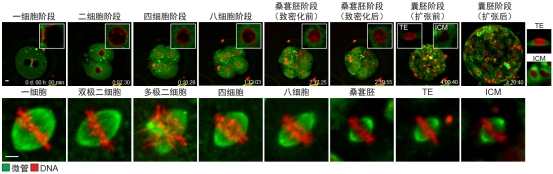
Microscopic Imaging of Human Pre-implantation Embryonic Development
Corresponding authors of the paper include Research Fellow Su Jun (National Institute of Biological Sciences, Beijing), Research Fellow Lin Ge (Central South University), Associate Research Fellow Xu Xiaoming (Beijing Jiayuan Hospital), Research Fellow Wang Hongmei (Institute of Zoology, CAS), and Research Fellow Yang Yun (Guangdong Institute of Intelligent International Medical Sciences). Co-first authors are doctoral student Li Zixuan (National Institute of Biological Sciences, Beijing), Associate Professor Leng Lizhi (Central South University), Associate Research Fellow Zhai Jinglei (Institute of Zoology, CAS), and Associate Research Fellow Wang Xiaowen (National Protein Science Center, Beijing). Academician He Fuchu from the National Protein Science Center, Beijing, provided crucial academic guidance for the study.
This research was funded by the National Key R&D Program of the Ministry of Science and Technology, grants from the National Natural Science Foundation of China, the Alibaba DAMO Academy Youth Star Award, and major research projects supported by CITIC Group.
Source: Central South University News Website
First Reviewer: Yang Cheng
Second Reviewer: Deng Haodi
Final Reviewer: Wang Jianxiang



