On April 21, a joint research team from Xiangya Hospital, Central South University and Shandong Provincial Hospital published an original research article online in Cell, entitled A skin-hypothalamus axis couples heat stress and metabolic dysfunction.
Professors Luo Xianghang, Associate Research Fellow Huang Yan from Xiangya Hospital and Professor Zhao Jiajun from Shandong Provincial Hospital serve as co-corresponding authors of the paper. Professor Zhou Haiyan, physicians Feng Xu and Wen Jie, and doctoral student Xiao Yao are co-first authors. Central South University acts as both the first affiliation and corresponding institution of this work.
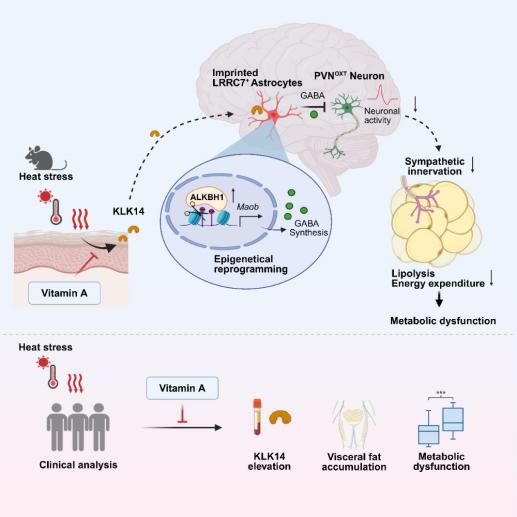
Against the backdrop of global warming, the team systematically investigated the correlation between heat exposure and metabolic disorders via population observation, mechanistic dissection and intervention validation. For the first time, the study reveals that heat exposure establishes persistent “heat memory” through a skin-hypothalamus axis and subsequently triggers metabolic dysfunction.
The research finds that heat stress upregulates skin-derived KLK14, which leaves epigenetic marks on LRRC7⁺ hypothalamic astrocytes. These heat-memory-bearing astrocytes modulate GABA synthesis via the DNA demethylase ALKBH1, suppress the activity of adjacent PVN-OXT neurons, and ultimately promote visceral fat deposition in a sympathetic nerve-dependent manner, impairing systemic energy metabolism. Further clinical cohort studies validate that vitamin A effectively inhibits KLK14 and alleviates metabolic disorders in heat-exposed populations. This discovery delivers innovative theoretical foundations and potential intervention targets for the precise prevention and treatment of metabolic diseases amid climate change.

The Department of Endocrinology at Xiangya Hospital has long conducted systematic research on environmental and genetic mechanisms of metabolic diseases. The team has built large-scale clinical databases and biobanks for metabolic disorders, published a series of high-impact papers in journals including Cell, Nature Medicine and Cell Metabolism, and led the formulation of multiple clinical consensus statements and guidelines for diagnosis and treatment.
First Reviewer: Huang Zhijun
Second Reviewer: Li Ruijun
Final Reviewer: Huang Gengwen



